Best USB Desk Fan for Bedrooms by Speed Control
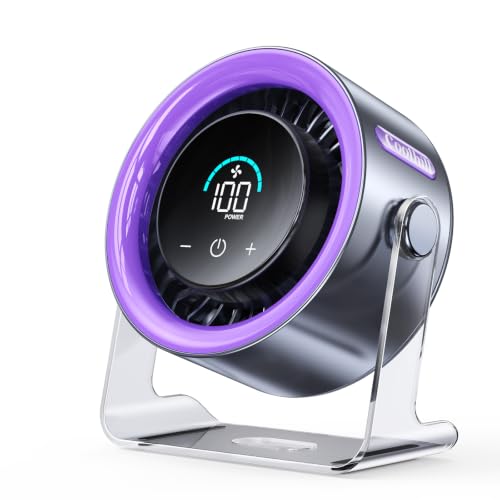
A nightstand fan lives or dies on how finely you can dial it down. Seven picks compared on speed steps, battery hours, weight and footprint, with the Coolhill ZH27 leading and a 2.6 lb Honeywell circulator for anyone who wants real airflow.

By Lynn FinchUpdated 19 min read
On this page
- Best usb desk fan for bedrooms at a glance
- Which buyer does each of these seven fans fit?
- Why speed steps matter more than wind speed
- 1. Coolhill USB Desk Fan for Bedroom: 100 Speeds Digital — Best overall
- 2. Honeywell TurboForce Air Circulator — Best for heavy use
- 3. KIMMOO Rechargeable USB Desk Fan — Best premium
- 4. DIGIX Portable Desk Fan — Most versatile
- 5. Gaiatop USB Desk Fan — Best for beginners
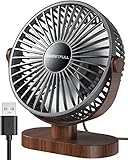
- 6. SWEETFULL Small USB Desk Fan — Best for families
- 7. TriPole USB Desk Fan Small Portable — Best budget pick
- How quiet is a quiet fan, really?
- Battery or cord: which belongs on a nightstand?
- What the listings do not tell you
- The verdict
- FAQ
The best USB desk fan for bedrooms is the Coolhill ZH27, because its 1-to-100 speed dial lets you park the airflow just below the point where you notice it, inside a body only 6.37 in tall. If your room genuinely runs hot and you want air moving across it rather than at you, the 2.6 lb Honeywell TurboForce HT-900 is the better buy. This one is not for everyone, though. If you need to cool a whole bedroom in July, none of these seven will do it, and a ceiling fan or a window unit is where your money belongs. Small fans move air past a person, not through a room.
Best usb desk fan for bedrooms at a glance
| Pick | Speed control | Power | Price |
|---|---|---|---|
| 100 steps | 3000mAh battery + USB-C |
Check Price | |
Best for heavy use Honeywell TurboForce Air Circulator |
3 speeds | Mains cord | Check Price |
Best premium KIMMOO Rechargeable USB Desk Fan |
100 steps | Battery, 8.5 hr claim | Check Price |
Most versatile DIGIX Portable Desk Fan |
100 steps | 3000mAh, 17 hr claim | Check Price |
Best for beginners Gaiatop USB Desk Fan |
3 speeds | USB cord | Check Price |
Best for families SWEETFULL Small USB Desk Fan |
3 speeds | USB cord, 4.7 ft | Check Price |
Best budget pick TriPole USB Desk Fan Small Portable |
3 speeds | USB-A cord, 4.9 ft | Check Price |



Which buyer does each of these seven fans fit?
I did not start with specifications. I started with the four people who actually buy a small bedroom fan, then worked out which listing fits each one.
- The light sleeper. Wakes at a change in sound. Needs the airflow set once and left alone at a low level. Fine speed control decides everything here, and only three of the seven offer 100 steps.
- The hot-room sleeper. Does not care about a whisper. Wants air genuinely moving. Only the Honeywell, at 2.6 lb and 10.9 in across, is built at a size that can do that.
- The renter or dorm sleeper. No spare outlet near the bed, nowhere to put anything. Wants a battery, or a fan on the wall. The DIGIX and the Coolhill cover this.
- The multi-room buyer. Needs three fans, not one, for kids' rooms and a home office. Price position and cord length matter more than a digital display.
That framing also explains what got cut. Anything without a published weight or footprint went, because a nightstand is a measured space. Tower fans and clip fans went, since a table fan is what the search asks for. What survived is seven listings that all publish dimensions, span every price position from cheapest to most expensive, and split cleanly into corded and rechargeable camps.
One thing to be straight about: bedrooms is a room, not a specification. No fan here is certified for sleeping or sold with a measured bedside noise figure you can audit. What you can compare is size, speed granularity and battery hours, and those are what I ranked on.
Why speed steps matter more than wind speed
Most small-fan guides compare top wind speed. That is the wrong number for a bedroom.
Here is why. At 3 a.m. you are not using the top setting. You are using the lowest setting that still moves air, and the useful question is how low that setting goes. A fan with three speeds gives you three answers. A fan with 100 steps gives you a hundred, and the difference between step 8 and step 20 is exactly the difference between falling asleep and lying there listening to a motor.
The set splits neatly:
- 100 steps: Coolhill ZH27, KIMMOO ZH28, DIGIX NS-11
- 3 speeds: Gaiatop TF40, TriPole KW37, SWEETFULL MWH-001, Honeywell HT-900
The Gaiatop listing is the most transparent about what three speeds actually mean, quoting 3.1 m/s at 1500 RPM on low and 4.0 m/s at 2000 RPM on high. That is a genuine jump between settings with nothing in between. Coolhill claims a maximum around 6 m/s and short-press stops at 1, 20, 40, 60, 80 and 100. Faster at the top, and far more choice at the bottom.
So the deciding criterion for the best usb desk fan for bedrooms is granularity, not power. Buy the top speed only if the room is hot enough that you will actually use it.
1. Coolhill USB Desk Fan for Bedroom: 100 Speeds Digital — Best overall
The 100-step dial plus a 3000mAh battery in a 6.37 in body makes this the most bedroom-shaped fan of the seven.
Best for: light sleepers who need a fan they can dial down to almost nothing Skip it if: you want to move air across a whole room
Three fans here offer 100 speeds. Only this one pairs that with 120° oscillation and a wall-mount option, and it is the fan buyers here choose most often out of the three. The footprint is the real story: 2.87 x 5.78 x 6.37 in fits behind a lamp and a glass of water without a fight. Coolhill says the built-in battery is 3000mAh and that charging runs about 2 hours over USB-C, so you can run it unplugged and top it up during the day.
The oscillation is what separates it from the KIMMOO, which shares the 100-speed dial but pivots rather than sweeps. A 120° sweep means the air arrives in waves instead of a constant stream on one side of your face. Coolhill also claims noise-reduction hardware and a turbo peak near 6 m/s, the highest claimed figure in this set. Treat both as the manufacturer's numbers.
The trade-off is straightforward. This is a personal fan with a 5.78 in frame, so it will never circulate a room the way the 10.9 in Honeywell does. It also sits in the more expensive half of the set and publishes no warranty, which the KIMMOO does.
Pros:
- 100 speed steps, finest control in the set
- 120° oscillation, unique among the battery picks
- Compact 2.87 x 5.78 x 6.37 in footprint
- 3000mAh battery plus USB-C charging
- Desk or wall-mounted use
Cons:
- No published warranty, unlike the KIMMOO
- Only one seller lists it
- Small frame limits whole-room airflow
- Sits in the pricier half of this set
2. Honeywell TurboForce Air Circulator — Best for heavy use
At 2.6 lb and 10.9 in across, this is the only pick here that moves air rather than just past you.

Best for: hot rooms that need real air movement all night Skip it if: your nightstand is small or you sleep lightly
This is the outlier of the seven, and the one buyers choose most often across the whole group. It is a circulator, not a personal fan: 10.9 x 10.9 x 6.3 in, 2.6 lb, a 90° pivoting head and an aerodynamic turbo grille that Honeywell says is built to maximise air movement. It has been on the market since 2012, and the HT-900 model number has not changed.
Honeywell claims it runs 25% quieter than comparable fans, which is a relative claim rather than a decibel figure, so read it as marketing. What it does not claim is whisper-quiet operation, and that honesty matters. A fan this size on high is audible. On low, from across the room, it is the pick I'd choose for a room that actually gets hot, because pointing it at a wall or ceiling gives you circulated air rather than a draught on one cheek.
Two real costs against the rest of the set. It has three speeds, not 100, so your low is whatever Honeywell decided it is. And it needs a wall outlet, with no battery. On the plus side it publishes a 1 year warranty, which only the KIMMOO matches.
Pros:
- Largest frame here at 10.9 x 10.9 x 6.3 in
- Genuine air circulation, not just personal cooling
- 1 year warranty published
- 90° pivoting head for ceiling or wall bounce
- Long-running model, unchanged since 2012
Cons:
- Only 3 speeds, no fine low setting
- 2.6 lb and too wide for a small nightstand
- No battery, needs a mains outlet
- No stated decibel figure, only a relative claim
3. KIMMOO Rechargeable USB Desk Fan — Best premium
The only battery pick that publishes both a decibel figure and a warranty.
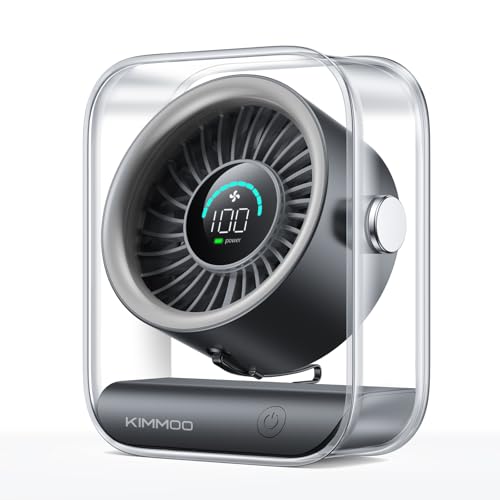
Best for: anyone who wants a stated noise figure and a published warranty Skip it if: you resent paying the most in the set
KIMMOO is the most expensive pick here, and what the extra money buys is documentation. The listing states 35dB at speed 1, 8.5 hours of runtime on a charge and a 2.5-hour recharge at 5V/2A. It also carries a 1 Year Warranty, one of only two in the set. Every other battery fan here leaves noise as an adjective.
At 0.92 lb and 6.58 x 5.5 x 3.11 in, it is heavier than the corded minis but still nightstand-sized. The 100-step dial and LED display work the same way as the Coolhill's, showing battery status and the current speed, which is genuinely useful when you are setting a level in the dark. KIMMOO claims a 200% power boost from the turbo motor, another manufacturer figure to take with salt.
What it lacks is the Coolhill's 120° oscillation, and that is the reason it sits third rather than first. You get the same fine control and a longer claimed runtime, but the air arrives from one fixed direction. For the highest price position in the set, that is a real gap. Only one seller lists it, too.
Pros:
- 35dB claim at speed 1, only stated figure here
- 1 Year Warranty published
- 8.5 hr runtime claim, 2.5 hr recharge
- 100 speed steps with LED battery readout
- Compact at 6.58 x 5.5 x 3.11 in
Cons:
- Most expensive pick in this set
- No oscillation, only a fixed direction
- Heavier than the corded minis at 0.92 lb
- Single seller on the listing
4. DIGIX Portable Desk Fan — Most versatile
A 17-hour battery claim and a wall hook make this the pick for a bedside with nowhere to put a fan.
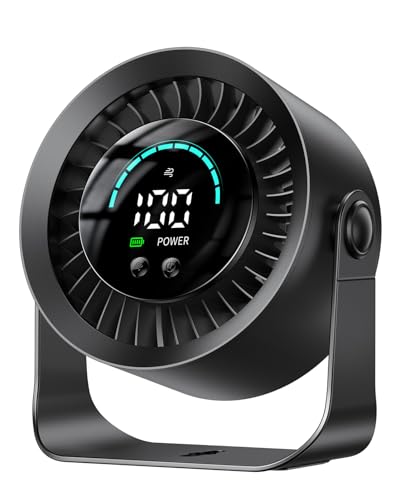
Best for: renters who want the fan off the nightstand and on the wall Skip it if: you need a fan the bedside table can hold up
DIGIX quotes the longest runtime in the set: 17 hours from a 3000mAh cell. That is double the KIMMOO's stated 8.5 hours from the same battery capacity, so the figure is presumably taken at a much lower speed. Read it as the manufacturer's best case, not a nightly guarantee. Still, it is the only listing here promising a full night plus most of the next day.
The 2-in-1 design is the genuine differentiator. DIGIX says a free adhesive hook is included so the fan can go on the wall above the bed rather than competing for nightstand space, and the head rotates 360°. Combine that with 100 stepless speeds and an LED display and you have the most flexible setup of the seven, especially in a dorm room or a rental where drilling is out.
Two honest problems. At 0.95 lb it is the heaviest of the battery picks, which matters for an adhesive wall mount more than it does on a desk. And it is the slowest seller of the seven despite sitting in the more expensive tier, with a single seller on the listing and no published warranty. The KIMMOO costs more but backs itself with a year.
Pros:
- 17 hr runtime claim, longest here
- Desk or wall-mounted with included hook
- 100 stepless speeds plus LED display
- 360° head rotation
- 3000mAh rechargeable cell
Cons:
- Heaviest battery pick at 0.95 lb
- No published warranty
- Runtime claim double a rival on the same capacity
- Slowest seller in this group
5. Gaiatop USB Desk Fan — Best for beginners
The clearest published speed figures in the set, in a 6.5 oz body you can pack.
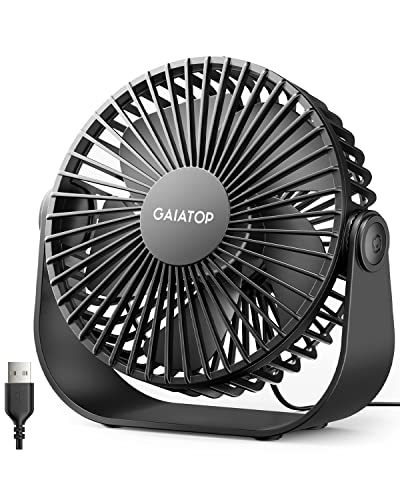
Best for: a first small fan you can also throw in a bag Skip it if: you need finer control than three speeds
Gaiatop is the pick I'd start with if you have never owned a bedside fan and do not want to overthink it. It is the second-cheapest here, weighs 6.5 oz, and measures 5.9 x 2.2 x 5.5 in with a 5.5 in blade span. Nothing to set up, nothing to charge.
What earns it a place is honesty about output. The listing publishes speed 1 at 3.1 m/s and 1500 RPM, speed 2 at 4.0 m/s and 2000 RPM, and a top speed above that. No other three-speed pick here gives you numbers you can compare. That transparency is worth more than a vague "ultra quiet" line, though Gaiatop uses that phrase too.
Practical details are sensible. The head tilts 90°, the base is wide with four rubber pads to damp vibration, and it runs off any USB source: laptop, power bank, wall adapter, car charger. At 2.2 in deep it disappears on a crowded nightstand.
The limits are the limits of three speeds. Your quietest option is 3.1 m/s and 1500 RPM, and if that is still too much air or too much noise, you cannot go lower. There is no battery and no published warranty, and only one seller stocks it.
Pros:
- Published m/s and RPM at each speed
- Only 6.5 oz, easiest to pack
- 2.2 in depth, slimmest footprint here
- 90° tilt and rubber-padded base
- Second-cheapest of the seven
Cons:
- Three speeds, no fine low setting
- No battery, cord only
- 5.5 in blade span limits reach
- No published warranty
6. SWEETFULL Small USB Desk Fan — Best for families
The widest airflow area of the corded minis, and the only one with a removable front cover.
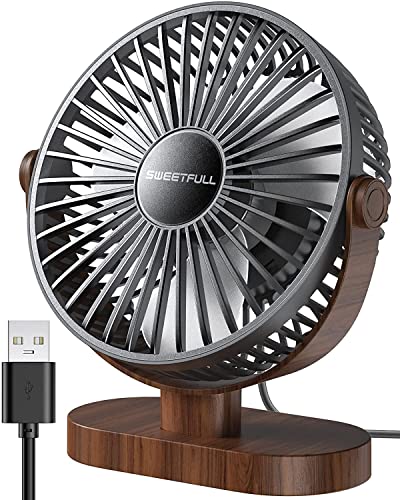
Best for: second and third fans for kids' rooms Skip it if: you want battery power or fine speed steps
If you are buying more than one fan, this is where I'd spend. It sits in the cheaper tier, weighs 7.05 oz, and stands 7.4 x 6.5 x 2.5 in, making it the tallest of the corded minis. SWEETFULL claims a 5.8-inch airflow area, wider than the Gaiatop's 5.5 in span, and quotes under 25 dB. That decibel figure is a manufacturer claim on a listing that elsewhere states two different weights, so treat it loosely.
The feature that actually matters for a child's room is the removable front cover. Blades in a kid's bedroom collect dust and worse, and being able to lift the grille off and wipe them is the difference between a fan that lasts a summer and one that gets thrown out. Nothing else here advertises that.
You also get 0-360° tilt, an anti-slip base and a 4.7 ft cable, plus a black wood grain finish that reads more like furniture than gadget. Three speeds on one button, so a child can work it.
The gaps are clear against the top picks. No battery, three speeds rather than 100, and the tallest body of the corded group at 7.4 in, which is a lot on a narrow bedside table.
Pros:
- 5.8 in airflow area, widest of the corded minis
- Removable cover for cleaning blades
- Under 25 dB claim from the listing
- 0-360° tilt with anti-slip base
- Cheaper tier, sensible for buying several
Cons:
- No battery, needs a USB outlet nearby
- Three speeds only
- Tallest corded pick at 7.4 in
- Listing quotes conflicting weights
7. TriPole USB Desk Fan Small Portable — Best budget pick
The cheapest of the seven, and the smallest footprint at 1.87 in deep.

Best for: the cheapest way to get air moving at a bedside Skip it if: you want a wide airflow area or a battery
TriPole is the cheapest pick here and the one I'd point at if the fan is going on a crowded nightstand next to a book, a phone and a lamp. It is 5.08 x 1.87 x 4.96 in and 6.3 oz, with a 4.5 inch blade diameter. That is the smallest air-moving surface in the set, and the price reflects it.
The 4.9 ft cord is the longest of the corded picks, which sounds trivial until you realise bedroom outlets are rarely beside the bed. TriPole runs from a 5V USB-A port, so a laptop, power bank or travel adapter all work, and there is no voltage issue abroad. The head rotates 360° up and down, and four silicone pads on a wide base are there to damp vibration.
Two sellers list it, the only pick here with more than one, which is a small point in its favour.
What you give up is airflow. A 4.5 inch fan is a personal breeze at close range and nothing beyond a couple of feet. Three speeds, no battery, no warranty and no published noise figure. Buy it as the low-cost option it is, not as a fan that will change how a hot room feels.
Pros:
- Cheapest pick in this set
- Smallest depth at 1.87 in
- 4.9 ft cord, longest of the corded picks
- 360° up-and-down head rotation
- Two sellers stock it
Cons:
- 4.5 in blades, smallest airflow area here
- Three speeds and no battery
- No published warranty or noise figure
- Short effective range from the fan
How quiet is a quiet fan, really?
Every one of these seven listings uses the word quiet. Two attach a number to it, and that gap is the single most frustrating thing about shopping the best usb desk fan for bedrooms.
Here is what is actually published:
- KIMMOO ZH28: 35dB at speed 1
- SWEETFULL MWH-001: under 25 dB
- Honeywell HT-900: "25% quieter than comparable fans", no figure
- Coolhill, DIGIX, Gaiatop, TriPole: adjectives only
Those two figures are not measured the same way, so do not put them side by side and conclude the SWEETFULL is quieter. One is quoted at a specific setting on a battery fan, the other on a corded mini with no setting named, and neither states a measurement distance. What they do tell you is that KIMMOO and SWEETFULL were willing to commit to a number, which is a mild signal about confidence.
The mechanical detail worth more than any of it is vibration control. TriPole, Gaiatop and SWEETFULL all describe a wide base with rubber or silicone pads. On a hollow wooden nightstand, a fan that buzzes through the surface is louder than a fan with a noisier motor sitting on felt. If your bedside table is thin MDF, the pads matter.
Battery or cord: which belongs on a nightstand?
This is the cleanest split in the set, and it decides more than the speed dial does.
Battery picks: Coolhill ZH27, KIMMOO ZH28, DIGIX NS-11. All three carry rechargeable cells, the two that state capacity quote 3000mAh, and claimed runtimes are 8.5 hours for KIMMOO and 17 hours for DIGIX. All three sit in the most expensive tier of this set. Coolhill charges over USB-C in about 2 hours by its own claim; KIMMOO quotes 2.5 hours at 5V/2A.
Corded picks: Gaiatop TF40, SWEETFULL MWH-001, TriPole KW37, Honeywell HT-900. The three USB minis are all in the cheaper tier. Cords run 4.7 ft on the SWEETFULL and 4.9 ft on the TriPole.
The trick most shoppers miss is that a battery fan is still a corded fan at night if the battery does not last until morning. An 8.5-hour claim at speed 1 is a full night only if you never touch the dial. So the honest rule is this: buy a battery if you have no outlet within reach of the bed, or if the fan will also travel with you. Otherwise, measure the distance from your nightstand to the nearest socket and check it against 4.7 ft before you spend the extra.
Batteries also age. A corded USB mini has fewer parts to fail, which is part of why the 2012-vintage Honeywell is still on sale.
What the listings do not tell you
Reading seven listings side by side makes the omissions obvious. Here is what none of them tells you, and how to work around each one.
- Noise at the setting you will use. Five of seven publish no decibel figure at all, and the two that do use different conditions. Assume you will need to try a couple of settings on the first night.
- Blade diameter, mostly. TriPole states 4.5 inch and SWEETFULL claims a 5.8-inch airflow area. For the others you are inferring from overall dimensions, so compare heights and widths and expect the blade to be a little under the frame.
- Warranty on five of seven. Only Honeywell and KIMMOO publish one, both a year. Silence is not the same as none, but you cannot plan on it.
- Whether the wall mount holds. Coolhill and DIGIX both offer wall mounting. DIGIX says an adhesive hook is included. Adhesive plus 0.95 lb over a bed is a judgement call about your paint.
- Any bedroom-specific certification. There is none. "Quiet bedroom fan" is a marketing phrase, and the room in the search term is not a feature any of these seven can prove.
The dimensions, weights and speed counts are the reliable data. Build your decision on those, and treat the adjectives as tone of voice.
The verdict
If you sleep lightly and want a fan you can set once and forget, the Coolhill ZH27 is the pick. The 100-step dial means you can find the exact level that moves air without registering as sound, and a 2.87 x 5.78 x 6.37 in body plus 120° oscillation fits a real nightstand. It is the best usb desk fan for bedrooms because it solves the problem a bedroom fan actually has, which is being too loud at its lowest useful setting.
If your bedroom genuinely gets hot, buy the Honeywell TurboForce HT-900 instead. At 10.9 x 10.9 x 6.3 in and 2.6 lb it is a different class of machine, and it circulates air through a room rather than blowing at one person. It also carries a 1 year warranty, which the Coolhill does not.
The cutoff is simple: if the fan's job is comfort at close range while you sleep, go Coolhill. If its job is to make the room itself feel cooler, go Honeywell and accept three speeds and a mains cord. The Honeywell's exact advantage over the Coolhill is frame size, and the Coolhill's exact advantage over the Honeywell is the lowest setting. Everything else in this set is a variation on those two answers, at a lower price or with a longer battery claim.
FAQ
Is a USB desk fan worth it for a bedroom?
A USB desk fan is worth it if you want air moving over you while you sleep, not if you want the room cooler. These fans move air past a person at close range. A 5.5 in blade cannot change the temperature of a bedroom. Buy one to make your side of the bed comfortable, and budget separately for a ceiling fan or an air conditioner if the room itself is the problem.
How much do you get for spending more on a bedroom fan?
Spending more on a bedroom fan buys you rechargeable power and fine speed control, not more airflow. The three most expensive picks here all carry batteries and 100-step dials. The cheapest, the TriPole KW37, has 4.5 inch blades and three speeds. Notably, the largest fan in the set, the 10.9 in Honeywell, sits mid-range, so a bigger machine does not always cost more.
Coolhill ZH27 or KIMMOO ZH28: which should you pick?
Coolhill ZH27 or KIMMOO ZH28 comes down to oscillation against documentation. Both offer 100 speeds, an LED display and a rechargeable battery. Coolhill adds 120° oscillation and a smaller 5.78 in frame. KIMMOO adds a stated 35dB low setting, an 8.5 hour runtime claim and a 1 Year Warranty, at the highest price position here. Choose Coolhill for the sweep, KIMMOO for the paperwork.
Will a USB desk fan run all night on battery?
Whether a USB desk fan runs all night depends on the speed you choose. DIGIX claims 17 hours from a 3000mAh cell and KIMMOO claims 8.5 hours from the same capacity, which tells you both figures come from very different settings. Plan on a full night at low speeds only. If you sleep with the fan on high, keep the USB-C cable within reach of the bed.
What mistake do people make buying a small bedroom fan?
The mistake people make buying a small bedroom fan is shopping the top wind speed. At night you use the lowest setting, so what matters is how quiet and gentle that setting is. A three-speed fan gives you one low option, whatever the maker chose. Check the speed count and the base pads before you check the maximum airflow figure.
Start by measuring two things: the depth of your nightstand and the distance to the nearest outlet. If the nightstand is narrow, the 1.87 in TriPole or the 2.2 in Gaiatop are the only picks that will not crowd it. If there is no socket within about 4.7 ft, you need a battery, which narrows you to three. Beyond that, the Coolhill ZH27 is the sensible default because it is the one pick that gets small, quiet-capable and adjustable into the same body, and because a fan you can dial down to almost nothing is a fan you will actually leave on all night.