Best Smart Desk Fan for Seniors: Quiet, Simple Picks

Five desk fans compared on the things that actually matter to an older user: how quiet they run, how heavy they are to move, and whether you can change the speed without standing up.

By Lynn FinchUpdated 15 min read
On this page
- Best smart desk fan for seniors at a glance
- Which features actually help an older user?
- How I narrowed this field down to five
- 1. DREO Smart Fan for Bedroom (DR-HAF008S) — Best overall
- 2. DREO Smart Fan for Bedroom (DR-HAF001S) — Runner-up
- 3. incihic Desk Fan (F25-7B) — Best for beginners
- 4. Honeywell TurboForce HT-900 — Best budget pick
- 5. DIGIX Portable Desk Fan (NS-11) — Best for small spaces
- How quiet is 20dB in a real bedroom?
- Weight, reach and where you put it
- When a different pick wins
- The verdict
- FAQ
The best smart desk fan for seniors is the DREO DR-HAF008S, because it runs as low as 20dB by DREO's claim and takes voice commands, so nobody has to stand up to change the speed. If you'd rather skip the app entirely, the incihic F25-7B does the same job with a remote and a lit display. Nine speed steps split this field more than airflow does. Every fan here moves enough air for a bedroom or a desk. Only some let you fine-tune the breeze without getting up, and that difference decides the purchase.
Best smart desk fan for seniors at a glance
| Pick | Noise claim | Control method | Price |
|---|---|---|---|
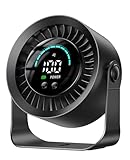
Best overall DREO Smart Fan for Bedroom (DR-HAF008S) |
20dB claim | App, voice, 9 speeds | Check Price |
| 28dB claim | App, voice, remote, 4 speeds | Check Price | |
Best for beginners incihic Desk Fan (F25-7B) |
25dB claim | Remote, LED display, 100 speeds | Check Price |
Best budget pick Honeywell TurboForce HT-900 |
"25% quieter" claim | Manual dial, 3 speeds | Check Price |
Best for small spaces DIGIX Portable Desk Fan (NS-11) |
"barely audible" claim | On-unit buttons, 100 speeds | Check Price |


Which features actually help an older user?
Amazon's search doesn't filter for age, and no manufacturer here publishes anything about senior use. So treat "for seniors" as your own checklist rather than a promise printed on the box. These are the things I'd judge each listing against, and you can check every one of them yourself on the product page.
- Can you change it without standing? Voice control, a remote, or an app. Three of the five here offer at least one.
- Can you read the setting from across the room? A lit display beats a printed dial in a dim bedroom.
- Can you lift it one-handed? Weights here run from 0.95 lb to 3.97 lb, a four-fold spread.
- Does the speed range include a genuinely low setting? Nine steps or 100 steps give you a whisper. Three steps may not.
- Is there a warranty on paper? Two of the five publish one. Two publish nothing at all.
One caution about voice and app control. It only helps if the setup is already done. Somebody has to connect the fan to Wi-Fi and pair it with Alexa or Google Home once, and if that person isn't the user, they need to be around on day one. After that, "Alexa, set the fan to speed three" is easier than any dial. Before that, it's a phone screen and a password. Weigh that honestly.
How I narrowed this field down to five
I sorted these by buyer, not by score, because the right answer changes completely depending on who's sitting in the chair.
- The person who already has a smart speaker. Voice control is the whole point. That's the DR-HAF008S first, DR-HAF001S second.
- The person who wants a remote and nothing else. No phone, no account. The incihic F25-7B and its lit display.
- The person who distrusts anything with an app. A dial you turn. The Honeywell HT-900.
- The person with almost no surface to spare. A nightstand shared with a lamp, a glass and a book. The 0.95 lb DIGIX NS-11.
What got cut: anything without a published weight, since a fan that has to be carried between rooms lives or dies on that number. Anything over roughly 13 inches tall, because these are desk and nightstand fans and a tower belongs in a different guide. And listings with no dimensions, since "will it fit next to the lamp" is the first question and you can't answer it from marketing copy.
I compared the published specifications side by side rather than the feature bullets, because bullets are written to sell and specifications are written to be checked.
1. DREO Smart Fan for Bedroom (DR-HAF008S) — Best overall
The only fan here with nine speed steps and hands-free voice control, which is exactly the combination that lets someone adjust the breeze without getting up.
Best for: someone who wants speed changes by voice, without leaving the chair Skip it if: you never want to set up an app or a smart speaker
This is the most expensive pick here, and the money buys control granularity. Nine speeds means the gap between "too still" and "too breezy" gets split eight times instead of twice, which matters a lot when you're sensitive to a draft on your neck or your knees. DREO claims 20dB at the lowest setting, the quietest figure published in this set. It also claims 950 CFM and airflow reaching 85 ft, plus 90 degrees of oscillation on both the vertical and horizontal axes.
At 3.97 lb it's the heaviest of the five, and 12.2 x 9.45 x 9.45 in is a real footprint on a nightstand. It's a two-hand carry between rooms. DREO publishes a 1 year manufacturer warranty and lists this as a 2026 model, and the listing offers an 8 or 12 hour timer, which is genuinely useful for anyone who falls asleep with the fan on.
The trade-off against the rest of this set: you pay the most and you lift the most, and the voice control that justifies both requires a working smart speaker in the room.
Pros:
- Quietest published figure here at 20dB claim
- Nine speed steps, more than any other pick
- 90° vertical and horizontal oscillation
- 8 and 12 hour timer options
- Published 1 year manufacturer warranty
Cons:
- Heaviest pick in the set at 3.97 lb
- Most expensive here
- Voice and app features need Wi-Fi setup first
- Largest footprint of the five
2. DREO Smart Fan for Bedroom (DR-HAF001S) — Runner-up
Half the weight of our winner with the same voice control, and the only pick here with a warranty that stretches past two years.

Best for: a lighter fan that still takes voice commands and moves room to room Skip it if: you want the widest speed range available here
At 1.95 lb this weighs less than half the DR-HAF008S, and that's the reason it's here. If the fan needs to move from the bedroom to the kitchen table and back every day, 1.95 lb is a one-handed lift and 3.97 lb isn't. It's also the only silver unit in this set, which reads less industrial in a bedroom.
The warranty is the standout on paper. DREO lists a 12-month default that extends to 30 months if you register the product. Nothing else here comes close. The listing claims 28dB, 70 ft of airflow, 90 degrees horizontal and 120 degrees vertical oscillation, a 12 hour timer, and app plus Alexa and Google Assistant control. Blade diameter is given as 7 in on a 13.19 in tall body.
The cost of that lower weight is control resolution. Four speeds against nine on the winner, and 28dB against 20dB. It also sells the slowest of the five here, which tells you something about how shoppers weigh those four speeds.
Pros:
- Lightest smart pick at 1.95 lb
- Warranty extends to 30 months with registration
- 120° vertical oscillation, widest tilt sweep here
- Voice control plus remote, no phone required day to day
Cons:
- Four speeds only, less fine control than the winner
- 28dB claim is louder than the 20dB winner
- Slowest seller of the five here
- Tallest body in the set at 13.2 in
3. incihic Desk Fan (F25-7B) — Best for beginners
A remote, a lit digital display and 100 speed steps, with no app account to create, which makes it the easiest starting point in this set.

Best for: someone who wants a remote and a big display, no phone involved Skip it if: you want a published warranty on paper
This is the pick I'd hand to somebody who has said, plainly, that they don't want another app. You get a remote in the box and a digital display that shows the setting, so there's no guessing which of three unmarked speeds you landed on. The listing claims 1 to 100 stepless speed levels, which in practice means you can dial the breeze down to almost nothing.
It sells faster than every pick here except the Honeywell, and it's the only one in the set with a battery: incihic claims a 10,000mAh cell, roughly 4 hours to charge, and 10 to 18 hours of running time. That matters if the nearest outlet is behind the bed. Noise is claimed at 25dB, oscillation at 90 degrees vertical and 120 degrees horizontal, with a 10 hour timer. At 8.66 x 5.55 x 8.27 in and 2.66 lb, it's compact without being tiny.
The gap against the DREOs is real, though: no warranty is published, no voice control, and only one seller lists it.
Pros:
- Remote and lit display, no app setup needed
- 100 stepless speed levels for a very low breeze
- 10,000mAh battery, 10 to 18 hours claimed runtime
- Second-fastest seller in this set
Cons:
- No warranty published on the listing
- No voice or smart speaker control
- Only one seller stocks it
- No published size or release date
4. Honeywell TurboForce HT-900 — Best budget pick
The cheapest of the five and the one buyers choose most often here, with three speeds on a physical control and nothing to configure.

Best for: a simple three-speed fan with a dial you can feel in the dark Skip it if: you want to adjust it without walking over to it
There's a reason this 2012 model still outsells everything else here by a wide margin. It does one thing, it costs the least of the five, and there is nothing to learn. Three speeds, a head that pivots 90 degrees, a 1 year warranty, and a control you operate with your fingers rather than your voice. For someone who finds screens frustrating, that's not a compromise. It's the point.
Dimensions are 10.9 x 10.9 x 6.3 in and weight is 2.6 lb, which makes it the squattest unit here and the easiest to tuck under a shelf. Honeywell claims it's 25% quieter than comparable fans, though no decibel figure is published, so you can't line it up against the 20dB and 25dB claims elsewhere in this guide.
Here's the honest limitation. Every adjustment means standing up and walking over. If mobility is the reason you're reading a guide about the best smart desk fan for seniors, that single fact may rule this one out no matter how good the rest of it is.
Pros:
- Cheapest pick in this set
- The one buyers choose most often here
- Physical controls, zero setup or pairing
- Lowest profile at 6.3 in tall
- Published 1 year warranty
Cons:
- No remote, no app, no voice control
- Three speeds only, the narrowest range here
- No decibel figure published
- Oldest design in the set, listed as a 2012 release
5. DIGIX Portable Desk Fan (NS-11) — Best for small spaces
At 0.95 lb and 6.58 x 5.5 x 3.11 in, this is the only pick that fits on a crowded nightstand or a walker tray without displacing anything.
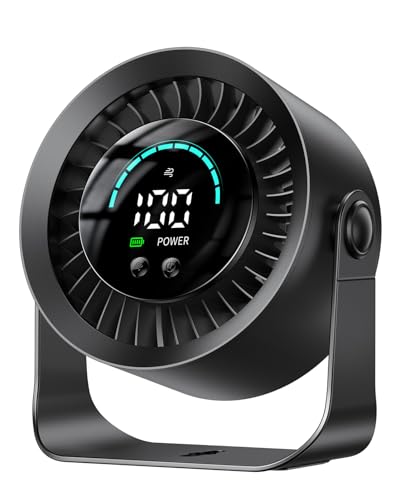
Best for: a nightstand or walker tray where nothing bulky will fit Skip it if: you need to cool more than the chair you're sitting in
Size is the whole argument. Nothing else here is under two pounds, and nothing else is barely three inches deep. If the surface next to the recliner already holds a lamp, a phone and a water glass, this is the fan that still fits. DIGIX also lists a wall-mount option with an adhesive hook included, which frees the surface entirely and gets the airflow up above tabletop clutter.
The listing claims a 3,000mAh battery with up to 17 hours of runtime, 100 stepless speeds, 360 degree rotation, and a large LED display showing the current setting. That display is worth more than it sounds on a fan this small, because the buttons are necessarily tiny and the readout tells you where you are.
The trade-off is reach. This is a personal fan, sized for the space within arm's length, and the specifications reflect that. There's no warranty published, no remote, and no voice control, so every change means touching small buttons on the unit itself.
Pros:
- Lightest pick here by a wide margin, 0.95 lb
- Only 3.11 in deep, fits a crowded nightstand
- Wall-mountable with the included adhesive hook
- LED display shows the setting at a glance
- 17 hours claimed battery runtime
Cons:
- No warranty published
- No remote or voice control, on-unit buttons only
- Small buttons are the hardest controls here to operate
- Personal-scale airflow, not room-scale
How quiet is 20dB in a real bedroom?
Decibel claims in this category are all manufacturer figures, measured under conditions nobody publishes, and they're always taken at the lowest speed. That's the first thing to know. DREO claims 20dB for the DR-HAF008S and 28dB for the DR-HAF001S. incihic claims 25dB. Honeywell claims only "25% quieter than comparable fans" with no number attached, and DIGIX says "barely audible levels".
So compare the claims to each other, not to a real room. Within this set, the ranking is clear enough: 20dB claim, then 25dB, then 28dB, then two picks with no figure at all.
What actually matters more is where the low end of the speed range sits. A fan with three speeds runs its quietest at whatever speed one happens to be. A fan with 100 stepless steps lets you sit at step 8 or step 12 and find a level that disappears into the background. That's why the incihic F25-7B and the DIGIX NS-11 can feel quieter in use than their spec sheets suggest, and why the nine steps on the winner matter as much as its 20dB claim.
If sleep is the priority, buy speed resolution before you buy a low decibel number.
Weight, reach and where you put it
Two numbers decide whether a desk fan gets used or gets shoved in a closet: how much it weighs and how deep it is.
Weight, lightest to heaviest across these five:
- DIGIX NS-11: 0.95 lb
- DREO DR-HAF001S: 1.95 lb
- Honeywell HT-900: 2.6 lb
- incihic F25-7B: 2.66 lb
- DREO DR-HAF008S: 3.97 lb
That's a four-fold spread, and it's the single most practical difference in this guide. Anything under 2 lb moves one-handed. Just under 4 lb means two hands and a clear path.
Depth matters just as much on a nightstand. The DIGIX is 3.11 in deep, the incihic 5.55 in, the Honeywell 6.3 in, and both DREOs sit above 9 in. Measure the surface before you order. Then check reach: DREO claims 85 ft for the DR-HAF008S and 70 ft for the DR-HAF001S, while the incihic and DIGIX publish no distance figure at all, which is consistent with their personal-scale designs. A bigger reach figure means less need to aim the fan precisely, and that's a real convenience when standing up to reposition it is the thing you're trying to avoid.
When a different pick wins
Three specific situations flip the recommendation away from the winner.
If nobody can set up Wi-Fi for you. Voice control is worthless until the fan is paired. If you're buying for a parent and you live three states away, the incihic F25-7B is the better buy: remote in the box, works out of the carton, nothing to connect.
If the fan has to travel with you. Bedroom to kitchen, or into a bag for a trip. The DREO DR-HAF001S at 1.95 lb handles the first case with voice control intact. The DIGIX NS-11 at 0.95 lb handles the second, with a battery that DIGIX claims runs 17 hours.
If the outlet situation is bad. Two picks here run on battery. The incihic claims 10,000mAh and 10 to 18 hours, the DIGIX claims 3,000mAh and 17 hours. Neither DREO nor the Honeywell publishes a battery, so both need a cord to a live socket.
One more threshold worth naming. If simplicity beats everything else, and the user has said clearly that they don't want anything with a screen or an account, the Honeywell HT-900 stops being the budget compromise and becomes the correct answer. Three speeds and a dial you can find in the dark is a feature.
The verdict
Think about this in three tiers.
At the entry end, the Honeywell HT-900 gives you three speeds, a 90 degree pivoting head and a 1 year warranty, with no setup at all. It's the cheapest here and the one buyers choose most often, and if manual controls are fine, stop reading. The DIGIX NS-11 sits at the same entry level but spends its budget on size instead, packing an LED display and a claimed 17 hour battery into 0.95 lb.
The middle tier is the incihic F25-7B, and it's the best value in this guide for anyone avoiding apps. A remote, a lit display, 100 stepless speeds and a claimed 10,000mAh battery, at the cost of a published warranty.
The premium tier is where you buy hands-free control. The DREO DR-HAF008S is the best smart desk fan for seniors overall because 9 speeds plus voice commands means the breeze gets adjusted whenever it needs adjusting, not just when someone's already standing. Its 20dB claim is the quietest published here. The DR-HAF001S trades four of those speeds for a 2 lb weight saving and a warranty that reaches 30 months with registration, and if the fan moves rooms daily, that's the smarter premium buy.
FAQ
Is a smart desk fan worth the extra money for an older user?
A smart desk fan is worth the extra money in one specific case: when getting up to change the speed is genuinely difficult. Voice control and app control mean adjustments happen from the chair. If mobility isn't a concern, the Honeywell HT-900's three speeds and physical dial do the cooling for less, with no pairing and no account to manage.
What is the quietest option among these picks?
The quietest option by published claim is the DREO DR-HAF008S at 20dB, followed by the incihic F25-7B at 25dB and the DREO DR-HAF001S at 28dB. All three figures are manufacturer claims measured at the lowest speed. Honeywell and DIGIX publish no decibel number, so you can't compare them directly on paper.
DREO DR-HAF008S or incihic F25-7B: which should I choose?
Choose the DR-HAF008S if there's already an Alexa or Google speaker in the room, since voice control is its whole advantage and 9 speeds give finer adjustment. Choose the incihic F25-7B if you want zero setup: it ships with a remote, shows the speed on a lit display, and runs on a claimed 10,000mAh battery with no Wi-Fi involved.
Do any of these fans run without being plugged in?
Two of these fans run without being plugged in. The incihic F25-7B lists a 10,000mAh battery with 10 to 18 hours of runtime and roughly 4 hours to charge. The DIGIX NS-11 lists 3,000mAh and up to 17 hours. Both DREO models and the Honeywell HT-900 need a mains outlet, with no battery published.
What is the biggest mistake buyers make in this category?
The biggest mistake buyers make is shopping on airflow figures instead of speed resolution. Every fan here moves enough air for a bedroom. What varies is the low end: three speeds may leave you between a draft and nothing, while nine steps or 100 stepless levels let you settle on a breeze you can sleep through comfortably.
Start with the surface you're putting it on. Measure the depth, then check it against the numbers in this guide, because a fan that doesn't fit next to the lamp never gets used no matter how well it performs. Once it fits, ask whether the user will realistically pick up a phone or say a command out loud. If yes, the DREO DR-HAF008S is the right default: nine speeds, a 20dB claim, and control that doesn't require standing. If no, the incihic F25-7B's remote and lit display get you most of the way there for less.