Best PC Fans for Home Office by Size and Noise

A size-and-noise comparison of six fans sold for home office use, from a 1.47 lb bladeless desk unit to a 120mm case fan rated at 1200 RPM. Winner named, conditions attached.

By Lynn FinchUpdated 16 min read
On this page
- Best pc fans for home office at a glance
- Three reasons picks got cut
- Desk fan or case fan: which one do you actually need?
- 1. Honeywell TurboForce Air Circulator HT-900 — Best overall
- 2. DREO Fan for Bedroom DR-HAF002 — Best premium
- 3. Amazon Basics Air Circulator Desk Fan — Best for beginners
- 4. Honeywell TurboForce Air Circulator HT-904 — Best for families
- 5. KONSIDEN Desk Fan Bladeless F6 — Best for heavy use
- 6. DARKROCK 3-Pack 120mm Black Computer Case Fans — Best budget pick
- How loud is quiet, and who is measuring it?
- Will it fit next to a monitor and a keyboard?
- What more money buys in this set
- The verdict
- FAQ
The best pc fans for home office use, judged across this set, is the Honeywell TurboForce HT-900: at 2.6 lb and 10.9 x 10.9 x 6.3 in it's the lightest of the four desk circulators and the one buyers here choose most often. If air has to reach the far side of a converted spare room instead of your face, the DREO DR-HAF002 and its 70 ft airflow claim is the better buy. This roundup is not for you if you came looking for RGB case fans with PWM headers and daisy-chain cables. That is a build-log purchase, and one 120mm three-pack aside, this set is desk hardware. Head to a dedicated case-cooling guide instead.
Best pc fans for home office at a glance
| Pick | Size (W x D x H) | Weight | Price |
|---|---|---|---|
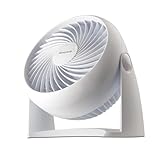
Best overall Honeywell TurboForce HT-900 |
10.9 x 10.9 x 6.3 in | 2.6 lb | Check Price |
Best premium DREO Fan for Bedroom |
11.8 x 10.8 x 9.5 in | 5.5 lb | Check Price |
Best for beginners Amazon Basics Air Circulator |
10.9 x 10.8 x 6.1 in | 3 lb | Check Price |
Best for families Honeywell TurboForce HT-904 |
11.3 x 11.1 x 6.54 in | 3.7 lb | Check Price |
Best for heavy use KONSIDEN Bladeless Desk Fan |
5.75 x 13.4 x 5.79 in | 1.47 lb | Check Price |
Best budget pick DARKROCK 120mm Case Fans |
4.72 x 4.72 x 0.98 in | Not listed | Check Price |




Three reasons picks got cut
Start with what did not make it, because the cuts explain the shape of this list better than the wins do.
- No published dimensions. A desk fan you cannot measure against your desk is a gamble. Every survivor here publishes a footprint, down to the 5.75 x 13.4 x 5.79 in of the KONSIDEN.
- Tower fans and pedestal fans. Anything over about a foot tall stops being desk hardware and starts being furniture. Six of the picks fit inside a 13.4 in longest dimension.
- Single-speed models. Four of the six run three speeds. A fan with one setting gives you a choice between "off" and "loud", which is not a choice at all.
What survived splits into two groups that a search for the best pc fans for home office lumps together. Four are small air circulators for the person sitting at the desk. One is a bladeless column. One, the DARKROCK three-pack, is an actual computer case fan at 120mm.
That split matters, so I gave it a section of its own below. Read it before you buy.
Desk fan or case fan: which one do you actually need?
This is the deciding question, and the keyword hides it. "PC fan" means two completely different products.
A case fan bolts inside your tower and moves heat off components. The DARKROCK three-pack is the only pick here that does that job: 120mm frame, 3-pin motherboard header, a claimed 1200 RPM maximum. It does nothing for the temperature of the room or the person in it.
A desk circulator moves room air. It cools you, not your CPU. The other five picks all do this, and none of them will lower a graphics card temperature by a single degree.
So the question is which thing is hot. If your machine throttles under load, or the case is stuffed in a cabinet cubby with one exhaust fan, buy the case fans. If you are uncomfortable at 3pm in a room the house thermostat has given up on, buy a circulator. Buying the wrong one is the single most common mistake in this category.
Here's the trick with home offices specifically: it's often both. A tower under a warm desk heats the footwell, and the footwell heats you. Case fans fix the source, a circulator fixes the symptom, and they cost different amounts of effort to install.
- Case fan: needs a free 120mm mount and a spare 3-pin header. Ten minutes with a screwdriver.
- Desk circulator: needs an outlet and a flat surface. Zero minutes.
1. Honeywell TurboForce Air Circulator HT-900 — Best overall
The HT-900 wins the best pc fans for home office comparison on footprint and pedigree: 2.6 lb, a 10.9 x 10.9 x 6.3 in body, and a 90-degree pivoting head that aims air at your face instead of your paperwork.
Best for: a desk where the fan has to sit close and stay out of the way Skip it if: you need to cool components inside a tower
Two numbers decide this one. The 6.3 in depth is the shallowest of the four bladed circulators here, which is what lets it live behind a keyboard rather than beside a monitor. The 2.6 lb weight is the lightest of those four, so moving it from desk to windowsill is a one-handed job.
It's also the fan buyers reach for most often across this whole set, by a wide margin. That's not proof of quality, but for a design that has been on sale since 2012 it does say the thing keeps selling on its own merits rather than on novelty.
Honeywell publishes a 1 year warranty and claims the TurboForce line runs 25% quieter than comparable fans. Treat that as marketing arithmetic with no named comparison set. What you can verify is the three-speed knob and the pivoting head, both standard here.
The trade-off against the DREO is reach. The HT-900 makes no published airflow-distance claim, and at 2.6 lb it is not a whole-room circulator. It is a personal one.
Pros:
- Lightest bladed circulator here at 2.6 lb
- Shallowest footprint of the four circulators, 6.3 in
- 1 year warranty published
- Bought more often than any other pick in this set
- 90-degree pivoting head and three speeds
Cons:
- No published airflow distance or noise figure
- Does nothing for internal PC temperatures
- Black only, which shows dust on a light desk
- Only one seller lists it
2. DREO Fan for Bedroom DR-HAF002 — Best premium
The DREO is the only pick in this set that publishes both a distance claim and a noise figure, and at 5.5 lb it's built to sit still while doing it.
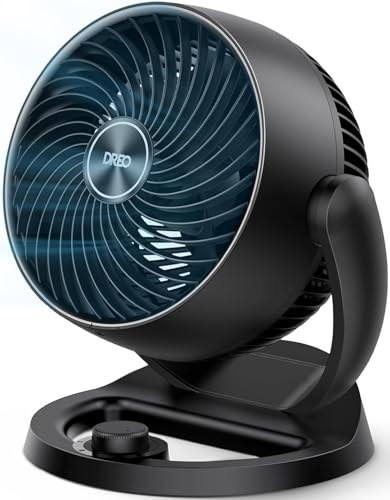
Best for: a converted spare room where air has to travel across the whole space Skip it if: your desk is shallow or shared with a docking station
DREO claims 70 ft of airflow reach from its WingBoost blade design and cites 25db at low speed. Both are manufacturer figures with no stated test conditions, and 25db is a low number for any moving fan, so read it as the quietest setting rather than the working one. Still, it's the only pick that puts numbers on paper at all, and that counts for something in a category where everyone says "quiet".
The physical cost is size. At 11.8 x 10.8 x 9.5 in it stands 3.2 in taller than the HT-900, and 5.5 lb makes it the heaviest thing here by more than 1.8 lb. On a shallow desk it becomes an obstacle. On a shelf or a filing cabinet across the room, that mass is an asset, because it will not walk on high speed.
The 120-degree tilt range beats the 90 degrees offered by the Honeywells and the Amazon Basics, and DREO says the front grille comes off for cleaning. A 1 year manufacturer warranty is stated. It's the most expensive pick here, and the specification sheet mostly justifies that.
Pros:
- Only pick with a published noise figure, 25db claim
- 70 ft airflow claim, the sole distance figure here
- 120-degree tilt, the widest in this set
- Heaviest at 5.5 lb, so it stays put on high
- 1 year manufacturer warranty
Cons:
- Tallest circulator at 9.5 in, awkward on a shallow desk
- Most expensive pick in the set
- Noise and distance claims are unverified manufacturer figures
- Sells more slowly than both the Amazon Basics and the HT-900
3. Amazon Basics Air Circulator Desk Fan — Best for beginners
A near-clone of the Honeywell layout with a published 35 W draw and the second-cheapest position in this set, which makes it the low-risk first purchase.

Best for: a first desk fan bought without much research Skip it if: you want a published warranty in writing
The specifications track the HT-900 closely: 10.9 x 10.8 x 6.1 in, 3 lb, three speeds on a rear knob, 90-degree tilt. The depth is actually 0.2 in shallower than the Honeywell's. Three 7-inch blades are stated in the listing, which is more blade detail than the Honeywells give you.
It's the only pick here with a published power figure, 35 watts at 120V. That's genuinely useful in a home office, where a fan may run eight hours a day beside a monitor, a dock and a printer on one circuit. Knowing the number beats guessing at it.
The gap against the HT-900 is documentation, not hardware. No warranty term appears in the listing data. For a fan you plan to run daily for years, that absence is worth weighing against the small saving, because the Honeywell publishes 1 year and the DREO matches it.
Released in 2023, and the second-most-bought pick here after the HT-900. For someone buying their first desk circulator and unsure whether they'll even like having one, this is the sensible entry point.
Pros:
- Second-cheapest pick in this set
- Only pick with a published wattage, 35 W at 120V
- Shallowest circulator depth at 6.1 in
- Three 7-inch blades and three speeds stated
- Second-highest sales position in this set
Cons:
- No warranty term published in the listing
- No noise or airflow-distance figures
- 3 lb, slightly heavier than the HT-900
- Black only, no lighter finish offered
4. Honeywell TurboForce Air Circulator HT-904 — Best for families
Same TurboForce engineering as the winner in white, which matters more than it sounds when the fan lives in a room the whole household walks through.
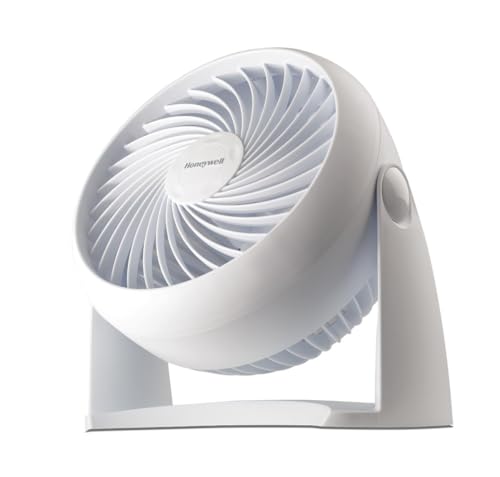
Best for: a shared room where a black fan would look out of place Skip it if: you move the fan between rooms all day
Four of the six picks here are black. The HT-904 is the only white bladed circulator, and in a home office that doubles as a dining room or a guest room, that's a real decision rather than a vanity one. White also hides dust better on a light desk, which is the maintenance reality of any fan running eight hours a day.
The mechanical package matches the HT-900: three speeds, 90-degree pivoting head, the same 25% quieter claim from Honeywell, and a 1 year limited warranty. Where they part company is bulk. At 11.3 x 11.1 x 6.54 in and 3.7 lb, the HT-904 is 1.1 lb heavier and marginally larger in every dimension than its black sibling.
That extra mass is stability, not power. Nothing in the listing claims more airflow than the HT-900, so you're paying a little more, for a heavier unit, to get white. Judge that on your room.
Skip it if the fan gets carried around. The 1.47 lb KONSIDEN and the 2.6 lb HT-900 are both easier to relocate mid-afternoon.
Pros:
- Only white bladed circulator in this comparison
- 1 year limited warranty published
- 3.7 lb gives it more desk stability than the HT-900
- Same three speeds and 90-degree pivot as the winner
Cons:
- Costs more than the HT-900 for no extra published capability
- 1.1 lb heavier and bulkier than the black version
- No published noise or airflow figures
- Only one seller lists it
5. KONSIDEN Desk Fan Bladeless F6 — Best for heavy use
The lightest and narrowest pick here at 1.47 lb and 5.75 in wide, with touch controls and no exposed blades to wipe out.

Best for: a cramped desk that needs a tall, narrow airflow column Skip it if: you want the strongest airflow per dollar
The shape is the argument. At 5.75 x 13.4 x 5.79 in this is a 13.4 in column occupying under 6 inches of desk width, where the four bladed circulators all eat 10.9 in or more. On a desk already carrying two monitors and a dock, that difference decides whether a fan fits at all.
At 1.47 lb it's less than half the weight of the Honeywell HT-904 and barely a quarter of the DREO. Pick it up with two fingers. The bladeless turbine design means the airflow slot wipes clean with a cloth, so there's no grille to unclip and no blade edges to dust, which is the maintenance win for a fan running all day, every day.
KONSIDEN publishes the strongest support terms in this set: a 12-month warranty, a 30-day free return window, and a stated 24-hour response commitment. Touch control replaces the knob.
The catch is value. This is the second-most-expensive pick, it makes no airflow or noise claim, and a narrow slot moves less air than a 7-inch blade at the same speed. You're buying the footprint and the finish.
Pros:
- Lightest pick in the set at 1.47 lb
- Narrowest desk footprint, 5.75 in wide
- No exposed blades, wipes clean
- 12-month warranty plus 30-day return stated
- Touch control and three speeds
Cons:
- Second-most-expensive with no published airflow figure
- Slowest-selling pick in this comparison by a wide margin
- Gray and dark red finish clashes with most desk setups
- 13.4 in tall, so it can block a monitor edge
6. DARKROCK 3-Pack 120mm Black Computer Case Fans — Best budget pick
The only genuine case fan here, and the cheapest pick in the set: three 120mm units, 1200 RPM claimed, 3-pin header.

Best for: a tower running hot under a desk all day Skip it if: you want cooling for yourself rather than your hardware
If the heat problem is inside the machine, this is the pick that addresses it and the other five do not. The frame is 120mm, the industry standard mount, listed at 4.72 x 4.72 x 0.98 in. DARKROCK claims nine blades, a 1200 RPM maximum, a 32.1 dBA noise ceiling, hydraulic bearings rated at an average 30,000 hours, and four silicone corner pads to damp vibration through the case panel.
That 32.1 dBA figure is worth reading carefully. It's a maximum, and three fans running together are louder than one. In a quiet home office, a 3-pin fan spins at whatever voltage the header gives it, so if your board offers only a fixed 12V header you get 1200 RPM and 32.1 dBA all day with no ramp-down.
It's the cheapest pick in this comparison, and a three-pack at that. For refreshing airflow in an older tower that has one tired exhaust fan, the value is hard to argue with.
The honest limitation: no published weight, no warranty term, and 3-pin rather than 4-pin PWM control. Also, nothing about it makes the room cooler.
Pros:
- Cheapest pick in the set, and a three-pack
- Standard 120mm mount fits most towers
- 1200 RPM and 32.1 dBA maximum claimed
- Silicone corner pads to cut vibration
- Bearings rated at 30,000 hours average
Cons:
- 3-pin, so no PWM speed ramping on most boards
- No published warranty term or weight
- Three fans together are louder than the single-fan dBA claim suggests
- Cools the computer, not the person at the desk
How loud is quiet, and who is measuring it?
Every listing in this set uses the word quiet. Only two attach a number, and they aren't comparable.
The DREO cites 25db. The DARKROCK case fans cite 32.1 dBA maximum. Those look close, but one is a room circulator at its lowest setting and the other is a 120mm fan at full tilt inside a metal box. Honeywell offers no figure at all, only the claim that TurboForce fans run 25% quieter than "comparable fans", with no comparison named.
What I'd actually watch for in the best pc fans for home office decision:
- Is the figure tied to a speed? A noise number without a speed is decoration.
- Does the fan have three speeds? Four picks do, which means you can trade airflow for silence during calls.
- Is the noise steady or does it pulse? Nothing in these listings tells you, and it's the difference between background hum and distraction.
Most shoppers miss the third point entirely. A fan at 32 dBA of smooth white noise disappears in ten minutes. The same level with a bearing tick does not.
Will it fit next to a monitor and a keyboard?
Measure before you buy. Desk fans are sold on airflow and bought on geometry.
Depth is the number that matters most, because it decides whether the fan sits behind your keyboard or beside your elbow. The Amazon Basics is shallowest at 6.1 in, the HT-900 next at 6.3 in, then the HT-904 at 6.54 in. The DREO needs 10.8 in of depth and 9.5 in of height.
The KONSIDEN plays a different game. It only needs 5.75 in of width, but it stands 13.4 in tall, which can clip the bottom bezel of a monitor on a low stand.
A rough rule for the best pc fans for home office setup: leave 2 in of clearance behind any bladed circulator so the intake isn't sucking against a wall. That turns the HT-900's 6.3 in into 8.3 in of real desk depth.
The case fans need different measuring. Check that your tower has a free 120mm mount with matching screw spacing, and check whether the header on your motherboard is 3-pin or 4-pin before you order.
What more money buys in this set
Across the six picks, the price ladder buys documentation and physics, in that order.
At the bottom, the DARKROCK three-pack buys quantity: three fans for the least money of anything here, with a full claims sheet but no warranty term. The Amazon Basics buys a proven layout and a 35 W figure, with no warranty stated.
In the middle, the two Honeywells buy a published 1 year warranty and a design that has been selling since 2012. The HT-904 charges a little extra purely for white.
At the top, the KONSIDEN buys the smallest footprint, the lightest body and the longest support terms, at 1.47 lb and 12 months. The DREO buys the only real performance numbers in the set: 70 ft, 25db, 120-degree tilt, 5.5 lb of stability.
What money does not buy anywhere here is verified sound output. Nobody publishes a standardised measurement, so the quiet claim stays a claim at every tier.
The verdict
Entry tier: if the heat is inside your tower, the DARKROCK 120mm three-pack is the only pick in this comparison that addresses it, and it's the cheapest thing here. If you just want your first desk fan and don't want to overthink it, the Amazon Basics gives you a 6.1 in depth, three speeds and the only published wattage figure, 35 W.
Middle tier: the Honeywell HT-900 is the pick I'd default to for most home offices. At 2.6 lb and 6.3 in deep it's the easiest of the bladed circulators to fit and move, it publishes a 1 year warranty, and it's the fan buyers here choose most often. Pay the small step up to the HT-904 only if you need white.
Premium tier: the DREO DR-HAF002 earns its position with numbers nobody else supplies. A 70 ft airflow claim and a 25db figure, plus 120-degree tilt and 5.5 lb of planted weight, make it the choice when a whole room needs moving air rather than one chair. The cutoff is desk depth. Under about 11 in of usable depth, take the HT-900. Over it, and with a room bigger than a box bedroom, take the DREO. If your desk has neither depth nor width to spare, the KONSIDEN at 5.75 in wide is the escape hatch.
FAQ
Are the best pc fans for home office use worth buying at all?
The best pc fans for home office use are worth it when a specific problem exists: a room the thermostat can't reach, or a tower that throttles under load. A 2.6 lb circulator like the HT-900 solves the first for very little money. Case fans solve the second. If neither problem is real, skip the purchase.
Which is quieter, the DREO or the Honeywell HT-900?
Comparing quieter claims between the DREO and the HT-900 is harder than it looks. DREO publishes a 25db figure; Honeywell publishes no number, only a claim that TurboForce fans are 25% quieter than comparable models. On paper the DREO makes the stronger case, because it commits to a figure. Neither is an independently verified measurement, so treat both as manufacturer claims.
Will a 120mm case fan fit my computer tower?
A 120mm case fan fits the most common mount in desktop towers, but check two things first. Measure the screw hole spacing on a free mount, and look at the header on your motherboard. The DARKROCK fans use a 3-pin connector, which means fixed-voltage operation on many boards rather than automatic speed ramping.
How much does a desk fan add to a home office power bill?
A desk fan adds far less to a home office bill than most people assume. The Amazon Basics is the only pick here publishing a figure, at 35 watts at 120V, which is a fraction of what a monitor or a laser printer draws. Run it eight hours a day and the cost stays trivial compared with the comfort gained.
What is the biggest mistake buyers make in this category?
The biggest mistake buyers make is confusing the two products a "pc fan" search returns. Case fans cool components inside a tower and do nothing for room temperature. Desk circulators cool the person and do nothing for a hot graphics card. Decide which thing is overheating first, then buy accordingly, or buy one of each.
Pick the problem before you pick the fan. If you're hot at your desk, order the Honeywell HT-900, put it behind your keyboard on the 6.3 in depth it needs, and leave a couple of inches of clearance for the intake. If your tower is the thing running warm, the DARKROCK 120mm three-pack costs the least of anything here and gives you three fans to work with. The HT-900 remains the safest default because it asks the least of your desk: 2.6 lb, three speeds, a pivoting head, and a warranty that's actually written down.